
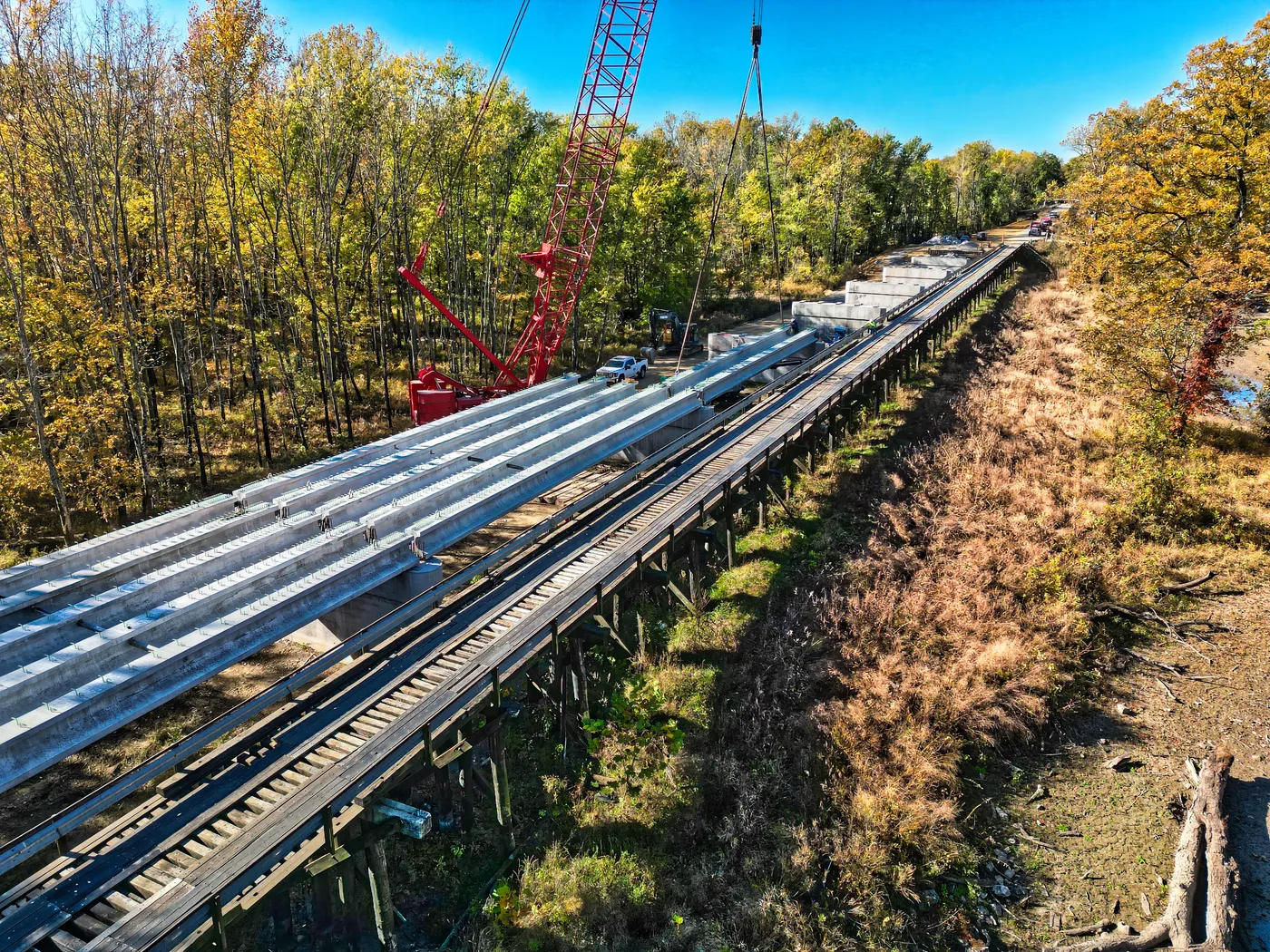
On September 30, the Illinois Department of Transportation published its Annual Highway Improvement Program for fiscal year 2027. It is the one-year piece of the six-year Rebuild Illinois program, and it itemizes the state and local highway projects programmed for the fiscal year that began July 1, sorted by district and phase.
The headline numbers: $6.4 billion, 1,303 miles of highway, 187 bridges, and safety or traffic improvements at 318 locations. About $850 million of that is money appropriated in earlier years for projects that are now scheduled to go. Of the total, $4.58 billion is for the state system and $1.82 billion is for local roads and bridges. The money is 58 percent state, 39 percent federal and 3 percent local.
Those are the figures that will show up in press releases. The part of the document worth reading twice is on page 3.
What IDOT says about its own bridges
IDOT writes that with the added funding from the federal infrastructure law and Rebuild Illinois, its pavement goals “will be met or nearly met.” Then it says this about bridges:
“However, the rate at which bridges are deteriorating will make it very difficult to meet the bridge targets, even with the additional investment provided by IIJA and Rebuild Illinois.”
That is the department’s own assessment, in its own program document, in the second year of a six-year program IDOT announced last October as the largest in state history. At the pace it is building now, IDOT does not expect to reach its bridge targets.
The scale of the inventory explains why. On the National Highway System alone, Illinois carries 4,843 bridges with 76.3 million square feet of deck. The American Road & Transportation Builders Association, working from the federal National Bridge Inventory, counts 26,927 bridges statewide, with 2,563 of them rated structurally deficient. That is 9.5 percent, the third-highest count of any state, and the number has been climbing: 2,407 in 2019, 2,472 in 2023, 2,517 in 2024, 2,563 in 2025.
The picture is not all one direction. Measured by deck area, which is how IDOT reports it, the NHS has been getting better: the share of interstate bridge area rated structurally deficient fell from 14.5 percent in 2019 to 9.5 percent in 2023, and other NHS bridges from 15.7 percent to 12.1 percent. The big decks are being handled. The count keeps rising anyway, which says the problem is spread across a large number of smaller structures.
Structurally deficient does not mean unsafe to cross. It means at least one key element is rated poor or worse, which makes the bridge a documented preservation, rehabilitation or replacement need. Illinois’s list is long and getting longer.
The FY 2027 bridge program
Bridge work is 23.5 percent of this year’s program, second only to roadway maintenance at 42.3 percent. In practical terms:
- State system: 96 bridges, 907,366 square feet of deck. Of the 65 NHS bridges programmed, 24 are structurally deficient.
- Local system: 91 bridges, 506,465 square feet of deck. Five of them are on the locally owned NHS, and all five are structurally deficient.
- New structures: 31,723 square feet of new bridge deck under system expansion.
Our own count of the project listing, which runs 49 pages and about 1,240 line items, finds bridge replacement in roughly 120 of them and culvert replacement or a new culvert in more than 50. Those are the line items where a plant-cast product is a direct fit.
Some of the larger bridge jobs IDOT calls out:
- I-190 at Mannheim Road, Chicago and Rosemont: bridge replacement, retaining wall, new auxiliary lanes, a new bridge and interchange reconstruction, $118.1 million.
- I-74 in Moline: reconstruction, bridge replacement and interchange reconstruction from south of 23rd Avenue to Illinois 5, $112.2 million.
- I-39/U.S. 51 over the Kishwaukee River, Winnebago County: bridge replacement and reconstruction, $96 million.
- I-57 at the Illinois 17 interchange, Kankakee: interchange reconstruction, bridge replacement and a railroad separation replacement, $89 million.
- Illinois 15 at the Kaskaskia River and overflow, Fayetteville: three structures, $87 million.
- Pershing Road over Racine Avenue and the Canadian National line, Chicago: bridge replacement, $56 million.
- I-57 in Iroquois County: superstructure replacement, new deck and joint work across several structures, $38 million.
- I-57 at Kirby Avenue, Champaign: bridge replacement, $17 million.
- I-70 at Illinois 32/33, Effingham: bridge replacement, $18.3 million.
- Illinois 75 over the Rock River, Rockton: bridge replacement, $20 million.
The full list, by district, is in the program document linked at the end of this article.
Where precast fits
A bridge engineer does not need to be told that prestressed concrete exists. Prestressed beams already carry a large share of Illinois state bridges. The useful question is which of this year’s 187 bridges should be a plant-cast product, in what section, under which IDOT standard, and who can deliver it inside the closure window.
The line items. Not every bridge dollar in the program is a precast opportunity, and the fit is not the $100 million interchange rebuilds at Mannheim Road and Moline. It is the bridge and superstructure replacements, the culverts, and the jobs where maintenance of traffic is the cost that matters. IDOT already specifies precast prestressed concrete deck beams in Bridge Manual Design Guide 3.5, and precast box culverts and three-sided structures are standard items. By our count of the listing, roughly 120 line items include bridge replacement and more than 50 include culvert replacement or a new culvert. Those are the jobs where a certified plant changes the closure, and the time to decide is Phase I and preliminary structure design, before geometry, staging and traffic assumptions lock in a conventional sequence.
The closure. Girders, deck beams, deck panels, pier caps, abutment pieces and box culverts are cast while the old structure is still carrying traffic. Forming, reinforcing, casting and curing leave the work zone. Demolition, erection, connections and approach work stay, but they compress into a closure measured in days instead of a season. IDOT has already done this. A paper co-written by the department’s Engineer of Bridge Planning lists the prefabricated elements IDOT has used on its system: deck panels, abutment and pier caps, wingwalls, parapets, deck beams and culverts. On Illinois 115 over Gar Creek in Kankakee County, the department set a new superstructure on precast semi-integral abutments, built it beside the old bridge, and slid it into place inside a 72-hour closure. On Peoria Street over I-290 and Campground Road over I-57, full-depth precast deck panels went in with ultra-high performance concrete joints. Those were demonstration projects. IDOT followed them with a rating scorecard so that future bridge projects get screened for accelerated construction at the planning stage.
The service life. AASHTO’s design life for a new bridge is 75 years. PCI says precast, prestressed concrete can deliver a 100-year service life when it is designed, detailed, made and maintained for it. The case rests on where the piece is made. Mix, cover, consolidation and curing happen under controlled plant conditions, under PCI plant certification, and are documented on every piece. Prestressing keeps the concrete in compression, which closes the cracks that let water and chloride reach the steel. Funding decides how many bridges IDOT can replace in a year. Durability, detailing and construction quality decide how soon it has to come back to the same one.
The season. Plants cast through the winter. Erection still has weather limits, but the forming, pouring and curing that need cold-weather protection in the field have already happened.
The ask
The FY 2027 program is public and sorted by district. IDOT also publishes a six-month letting look-ahead on the same page. If a Phase I report is still open on one of the short-span replacements, IDOT’s own ABC scorecard is the place to put the question. Chapter producers holding PCI’s bridge certification categories, including the B-IL designation that adds Illinois DOT requirements, can price deck beams, box culverts and girders against that look-ahead now. They are listed on our transportation page.
Sources
- Illinois Department of Transportation, FY 2027 Proposed Highway Improvement Program, published September 30, 2026. Program totals, core work categories, bridge counts, NHS statistics, the quoted statement on bridge deterioration, and the project listing.
- Illinois Department of Transportation, Executive Summary, FY 2025-2030 Proposed Highway Improvement Program, the structurally deficient deck area trend, and the October 1, 2025 announcement of the FY 2026-2031 multi-year program.
- American Road & Transportation Builders Association, Illinois bridge profile, 2025 report from FHWA National Bridge Inventory data, the 2025 national report and 2024 national report for the state rankings and the 2024 count, and the 2023 state profile for the 2019 and 2023 counts.
- Eric J. Ozimok (AECOM) and Patrik Claussen (IDOT Engineer of Bridge Planning), “Is ABC a Good Fit? Development of the Illinois Department of Transportation’s Accelerated Bridge Construction Evaluation Method”, ABC-UTC, Florida International University.
- Precast/Prestressed Concrete Institute, Durable: Precast for Tomorrow, the 100-year service life statement.
- Illinois Department of Transportation, Bridge Manual Design Guide 3.5, LRFD PPC Deck Beam Design, May 2019.